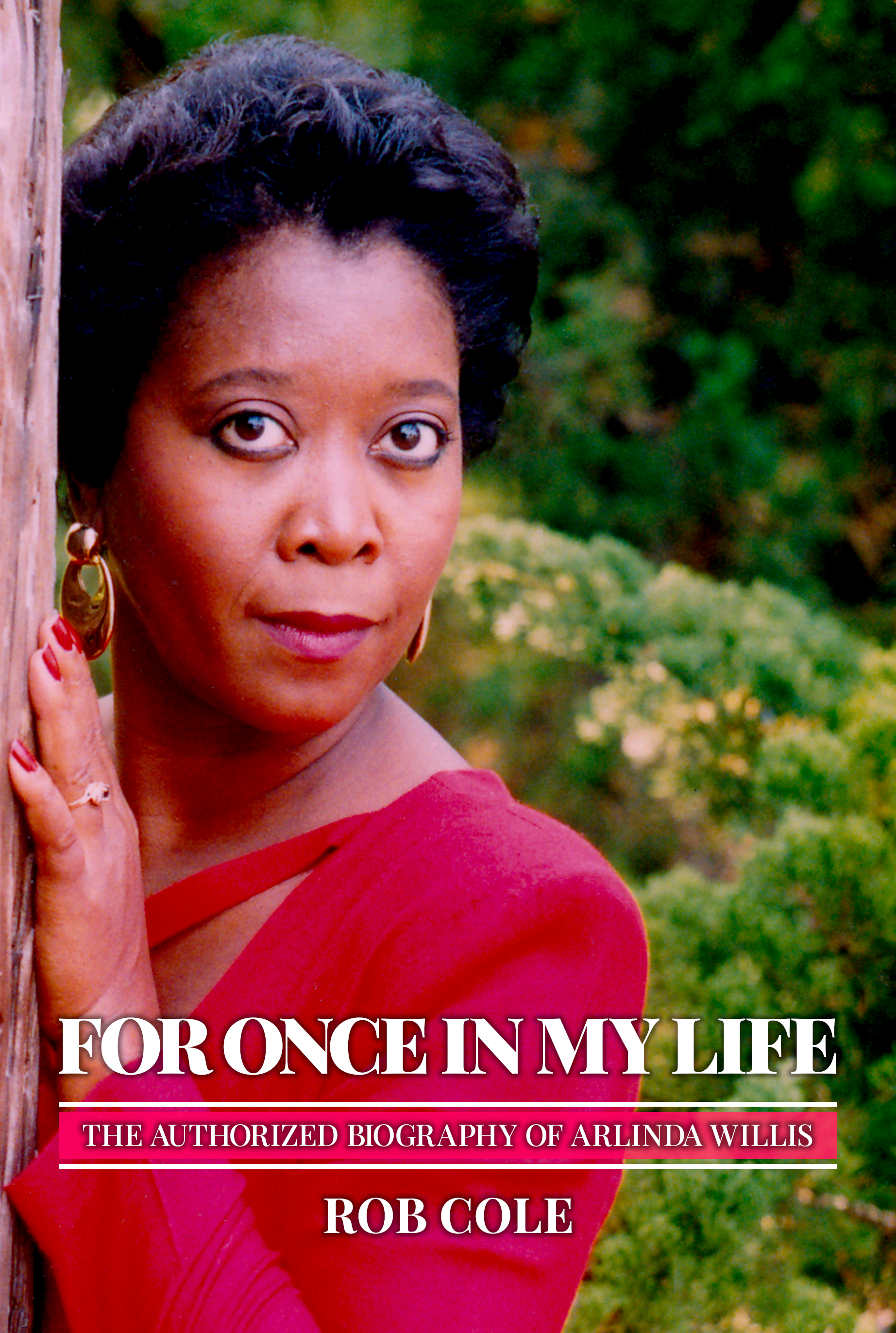
For Once in My Life Press Release
HAWAII, August 27, 2026 — FOR IMMEDIATE RELEASE
Authorized Biography of Arlinda Willis Published on Her 75th Birthday, the Anniversary of “I Have a Dream”
For Once in My Life chronicles a Black woman who spends a lifetime proving her worth to the world, her family, and herself, only to find that she is enough just as she is.
HAWAII — On what would have been her 75th birthday, and the 63rd anniversary of Dr. Martin Luther King Jr.’s “I Have a Dream” speech, the authorized biography of Arlinda Willis is published today. For Once in My Life: The Authorized Biography of Arlinda Willis, written by Rob Cole and published by Margot Erickson Publishing, Inc., is the culmination of research and interviews that depict the disparities of the color and gender lines in America.
Arlinda Willis was born on August 27, 1951, in Toxey, Alabama, an agricultural turned textile manufacturing town with Jim Crow racism at its core. To reunite with her mother, who had abandoned her a decade prior, she traveled north during the final phase of the Great Migration. Arriving in Cleveland, Ohio, she vied for her mother’s attention by becoming a professional dancer on television, a model, competing in the first Miss Black Cleveland beauty pageant. She moved to San Francisco, got married and quickly divorced, and suffered through lackluster office jobs and a non-existent love life, using alcohol as a coping mechanism. A co-worker, Rob, helped her overcome alcoholism, only for her to develop cancer a few months later. Illness made professional achievement impossible and she discovered, at last, that the love and approval she had been seeking all of her life had been there with Rob. It was a personal achievement she could still win.
“Arlinda wanted to be recognized,” says Rob, who spent nearly two decades as Willis’s close friend and caregiver during her final years. “She asked me to write her biography so people would understand the barriers that Black women must scale for success.”
The biography spans six decades, taking us through the sharecropping community of the Alabama Black Belt; Cleveland during the Hough riots of 1966; the television stages of the hit-parade format Upbeat show; the corridors of the Thelen law firm in San Francisco; and the tumultuous final chapter of a woman learning that sometimes it is better to receive than to give. Along the way, Willis navigates medical racism, the institutional indignities that shaped the lives of Black women across the 20th Century, and the slow romantic burn of an interracial, inter-generational relationship navigated with humor and love.
Written by a British-born author who came to the story as an outsider and witnessed the last third of her life, For Once in My Life joins a small shelf of biographies that examine the resolve of a Black woman trying to navigate the American dream. It is written for anyone who has struggled to be seen.
ABOUT THE AUTHOR
Rob Cole began writing in 1993, with his short story, “Brenin”, first published in The Anthologist, Rutgers University’s literary magazine. After earning his degree in English with specializations in Creative Writing and Comparative Literature, he crafted stories for non-profits such as the International Fund for Africa, and Steriliseren Nederlands. His fundraiser picture book, HOPE, showcased the impact of pioneering Spayathons on Romania. In 1997, he built an immersive virtual reality world to display his short stories. As social media grew, so did his writing, expanding into multimedia storytelling.
Rob met Arlinda Willis while working at a San Francisco law firm. The two formed a friendship that spanned 18 years. He documented her teenage brushes with fame, her rise in the legal world, and her battle with illness. As her caregiver, he meticulously recorded her medical journey. For over 14 years, he shaped her biography, FOR ONCE IN MY LIFE. Determined to honor her voice, this story puts a face on medical racism, which exists even in the liberal bubble of the San Francisco Bay Area.
Rob Cole is an author/publisher, and entrepreneur. Born in England, he spent nearly two decades as a close friend and caregiver to Arlinda Willis. FOR ONCE IN MY LIFE is his first biography. He writes at robcoleauthor.substack.com.
BOOK SUMMARY/SYNOPSIS
FOR ONCE IN MY LIFE is a braided biography/memoir that chronicles the life of ARLINDA WILLIS, a Black woman born in 1951 in rural Alabama. Her formative years were surrounded by poverty, Jim Crow racism, Civil Rights tension, and sexual violence within her family. Before her 12th birthday, she reunited with her mother in Cleveland, Ohio, where she flourished in the entertainment industry. She earned a position as a dancer on the iconic TV show Upbeat, performing alongside Stevie Wonder and James Brown. She won a trophy half her size in the first Miss Black Cleveland beauty pageant in 1970, and pursued a modeling career while working at Eastman Kodak. Despite all of her accomplishments, her family ignored her.
Rising through the ranks of Eastman Kodak, she was transferred to San Francisco. She built a career in White male-dominated work environments and became a legal secretary at a top-100 law firm, THELEN. It was at Thelen where she met ROB COLE and, over the next 18 years, developed a flirtatious yet platonic friendship into an interracial, inter-generational romance.
During the Great Recession, Arlinda was right-sized from Thelen, where she slid into alcoholism. With Rob’s assistance, she overcame her addiction months before a tumor developed in her esophagus. She underwent surgery, chemotherapy, and radiation, becoming cancer-free four months later.
This story shows how the news stories of the time shaped her life before they were logged in the history books. It exposes how being a Black woman adversely affected her medical care. She struggled with trust issues, yet yearned for a deeper connection with someone. Throughout her medical trials, she learned to seek support from others and eventually developed a trusting relationship with Rob.
KEY THEMES
The Great Migration
Arlinda Willis was part of the second wave of the Great Migration. It was a mass movement of about six million Black Americans from the Jim Crow South to the cities of the North and West in search of dignity, safety, and opportunity.
Jim Crow Alabama
Arlinda grew up in Choctaw County, Alabama, where the laws were designed to ensure that Black people remained poor, voiceless, and immobile. For Once in My Life recovers the texture of that world: the three-bedroom house built just after the Civil War, the farm that sustained a family without ever enriching it, and the Civil Rights movement that squelched the dreams of the Black residents.
Medical Racism and Healthcare Inequality
In the final chapter of Arlinda's life, the American healthcare system failed her through undertreated pain, dismissed symptoms, and the documented gap between what her doctors said to her face and what they recorded in their notes.
The Civil Rights Era as Lived Experience
Arlinda came of age at the precise moment when the Civil Rights Movement was reshaping the South. For Once in My Life depicts the Civil Rights era as the daily reality of a young Black woman deciding what kind of life she was going to demand for herself.
Interracial Friendship
The biography was written by Rob Cole, a white British man who met Arlinda Willis in San Francisco in 1994 and spent the next 18 years as her close friend and biographer. Their friendship is a thread running through the book, and one of its most quietly radical arguments.
Caregiving and Bearing Witness
To care for someone through a long illness is to be changed by it, to learn what a person is made of when performance is no longer possible, and to carry that knowledge forward when they are gone. For Once in My Life is an account of what it means to be fully present for another person's life, including the parts that are hardest to watch.
Authorized Biography
Arlinda Willis asked Rob Cole to write her biography, an account of a life as witnessed and researched by someone who loved her and was committed to the truth of her. Written with the full cooperation and blessing of her family, For Once in My Life is an authorized account of the portrait Arlinda Willis chose to leave behind.
FACT SHEET
Title:
For Once in My Life: The Authorized Biography of Arlinda Willis
Author:
Rob Cole
Publisher:
Margot Erickson Publishing, Inc.
Publication Date:
August 27, 2026
Format:
Trade Paperback and eBook
ISBN:
Hardcover 979-8-9957094-1-1
Paperback 979-8-9957094-2-8
Large Print/Accessible 979-8-9957094-3-5
eBook 979-8-9957094-4-2Price:
$28.99 (hardcover) | $18.99 (paperback) | $8.99 (eBook)
Available:
Amazon, IngramSpark, bookshop.com
EXCERPT (Advanced Reader Copy, subject to final edit)
Nancy Mootz and Doug Washington created Vertigo at the base of the Transamerica Pyramid. Arlinda had wanted to take Rob to the new restaurant since it first opened in 1995. In the late ’70s, the space was a disco and supper club, known as Park Exchange.
The two friends were seated in the lower section of the split-level room, right where one of the dance floors had shined. Her fingers brushed over the table, searching for echoes of the rhythm that once filled the space.
Arlinda turned her head toward Rob, her brown skin glowing in the ambient light. “I used to dance up a storm right here, into the early morning,” she said, pointing to the wooden floor. She swayed in a trance as her thoughts drifted to disco-thumping basslines and soaring melodies.
Her memories drew her back to 1979, gazing at the floor, no longer polished for diners but for dancers. This wooden square had been one of her stages where she released wild and fearless energy. She imagined how the sweeping strings of Ain’t No Stoppin’ Us Now had lifted her, how the lights had shone upon her cheeks as she danced in ecstasy. If she could live in this memory forever, she would. Over the years, longer stretches of time passed between visits to her younger self, until now they were almost strangers. She looked back at Rob, returning to the present.
“Yeah, I vaguely remember disco,” he mused, leaning in.
Vaguely? She let the sting shudder through her old bones.
“I’d love to hear about those parties,” he added.
They had known each other for almost a year, yet there was still so much more to explore. Arlinda crossed her forearms on the table and leaned toward Rob. “You really want to know?”
“Of course.” Rob shrugged, dismissing any doubts. “I’d love to know more about you. And it seems the waitstaff are giving us plenty of time today.”
The kitchen was slow that afternoon, taking over two hours to prepare and serve their food. Their lunch stretched into nearly three hours. Arlinda used the time to share snippets of her somewhat famous past with her audience-of-one.
Her family knew her as Linda. From 1966 to 1968, she danced on Cleveland’s music hit parade show, Upbeat. The year she joined, the show changed its name from The Big 5 Show when it became nationally syndicated. It could no longer guarantee its original Saturday 5 p.m. time slot. The dancers performed between sets and sometimes during the acts. She had “Freddied” and “Moused” with legends like Stevie Wonder and James Brown.
Arlinda had won a trophy half her size in the first Miss Black Cleveland beauty pageant. She told Rob she had toured with Rare Earth as a stage dancer, but it could have been with the drummer, Peter Rivera, who left the group in late 1974 to start his own band. When her spotlight turned off, she settled in San Francisco.
Fond memories of her fearless younger self now felt removed from the woman she had become, a modern businesswoman defined more by office memos than the limelight. Yet, as she spoke, those two selves collated like pages in a lateral file cabinet.
“It never occurred to me,” Rob repositioned himself on the dining chair. “Your past was so fun.”
“What you talkin’ ’bout, Willis?” She laughed nervously. Between sips of iced tea, she recounted her early childhood in Alabama. By the age of four, she could sing and dance at church with the best of them. When she was five or six, a boy challenged her to a pissing contest—she lost. Her grandparents raised her until she was eleven. They ran a small farm with a plow horse, chickens in a coop for eggs and sometimes meat, usually two pigs in a pen, and two dogs. Her mother moved to Ohio shortly after giving birth to her, part of the second wave of the Great Migration. Once her mother found a stable home in Cleveland, she sent for her daughter and her parents to....
Arlinda paused, taking a shallow breath, resisting the pull of memories. There would be more time someday.
“One day, I’ll write a book about my life.” She studied his face to see if her dream was silly. “You think anyone would read it? There were some tough times, too.” She glanced at her hands, reeling the painful stories back inside. That lunch was the beginning of her book, with future pages to be written at the right moment, which never seemed to come.
“I’ll help you write it. It’ll be a great way to know each other on a deeper level.” Rob recalled how he had moved to San Francisco with dreams of working in publishing, only to be relegated to the legal world by the whims of a temp agency.
A smile twinkled on her lips. “I’d like that,” she said. But there was a hesitation behind her words, maybe even a fear of revisiting her 11-year-old self. Still, life often got in the way. Years slipped by in a blur. Her autobiography, the one that could hold her hopes, dreams, and even her nightmares, remained an aspiration. With Rob’s motivation, maybe now the story could begin.
By the time the sizzling plates arrived, lunch seemed almost an afterthought. Arlinda leaned back in her chair. Her story spread out between them as leftovers from a feast. The words had flowed without effort. For the first time in a long time, she could see the shape of who she had become, alongside the girl she used to be.
# # #